Video Survey Lab: Building an AI-Assisted Video Research SaaS
A live SaaS MVP built to make video-based qualitative research more accessible—available at videosurveylab.com.
Overview
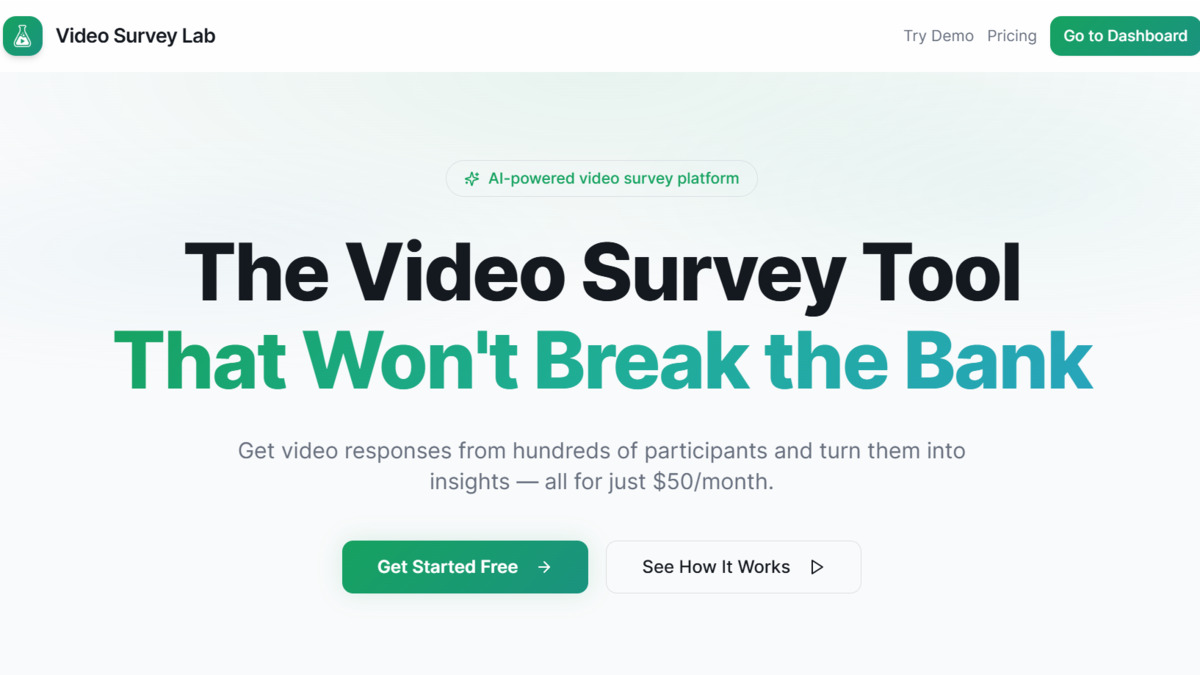
I turned an expensive internal customer-research need into a working SaaS product — serving as founder, product strategist, marketer, customer researcher, and AI-assisted builder. Video Survey Lab is a video-survey platform designed to make qualitative research more accessible for marketers, product teams, researchers, and lean organizations, without sacrificing transcription, analysis, and export capabilities. The product is a live MVP in early customer-validation stages, priced at $50/month for the Pro plan, built using OpenAI for planning and strategic review and Replit for AI-assisted development and iteration.
Project Snapshot
- Role
- Founder, product strategist, customer researcher, marketer, and AI-assisted builder
- Problem
- An internal customer-research need required video feedback, transcription, and analysis, but existing tools were too expensive for a lean budget.
- Build
- Live SaaS MVP for video surveys, consent collection, transcription, AI-assisted analysis, and CSV export.
- Tools
- Replit, OpenAI, Supabase, and AI-assisted development workflows
- Validation
- ~200 prospects contacted, 124 accepted connections, 41 positive replies, and 12 early users
- Status
- Live MVP with early user interest; willingness to pay, recurring usage, and scalable acquisition are still being tested.
The Opportunity
The idea for Video Survey Lab began with a customer-research problem. I wanted a way to connect with customers at scale while still hearing about their experiences in their own words, but the best available tool cost approximately $280 per month — far beyond what our lean budget could support.
Rather than abandoning the idea, I decided to recreate the core experience for my own use. Once the first version was working, I realized that thoughtful product decisions had allowed me to deliver the experience at a dramatically lower cost.
Most established video-research platforms are designed and priced for larger companies and agencies. I believed that lean teams, freelancers, consultants, researchers, and entrepreneurs would be interested in a simpler product offering easy participant recording, searchable transcripts, AI-assisted analysis, consent collection, and straightforward export — all for $50 per month.
The initial positioning centered on affordability. Customer conversations later showed me that price was important, but that the frequency and context of use would be just as important to the product’s long-term viability.
From Idea to Working MVP
I used OpenAI to help translate the initial concept into structured requirements, workflows, feature priorities, and product documentation. I also used it throughout the project as a strategic feedback and review partner.
I then used Replit’s AI-assisted development tools to turn those requirements into a functioning application.
The core workflow was operational within approximately three days:
- A user could create a survey.
- A participant could open it and record video responses.
- The platform could store and organize the responses.
- The researcher could review, transcribe, analyze, and export the resulting feedback.
Building the first version quickly allowed me to prove that the concept was technically feasible. Creating a product that felt reliable and intuitive required substantially more work.
Over the following months, I refined the customer-facing experience, improved mobile performance, tested the product with users, worked through its unit economics, and continued developing its positioning. The total process spanned approximately three months, including periods when the project was not under active development.
The experience reinforced an important distinction: AI-assisted tools can make it possible to build a product very quickly, but creating a trustworthy customer experience still requires product judgment, testing, iteration, and attention to detail.
Key Product Decisions
1. Prioritizing the participant recording experience
A video-research product is only useful if participants can record and submit responses without unnecessary friction.
The initial mobile recording experience did not work consistently enough. This became one of the project’s most difficult development challenges because a large portion of respondents would encounter the survey on a phone rather than a desktop computer.
I repeatedly tested and refined the mobile workflow until participants could move through the recording process more reliably. This work shaped how I thought about the product: the respondent experience was not a secondary interface. It was the foundation of the product’s value.
2. Treating cost control as a product-design problem
Video storage, transcription, and AI analysis all create variable costs. Allowing unlimited video length, uncontrolled processing, or unnecessarily expensive workflows would have made the lower price point impossible.
I designed constraints into the product that allowed it to provide substantial practical usage while keeping delivery costs manageable. These included limits around response length, deliberate processing workflows, and a feature set focused on the highest-value parts of the research experience.
Instead of treating those constraints as purely financial limitations, I treated them as product decisions. The goal was to give most users more than enough capacity while avoiding features that would increase costs faster than they increased customer value.
3. Building consent into the workflow
Because the product could be used for customer research, testimonials, and other forms of recorded feedback, participant consent needed to be part of the experience rather than an afterthought.
I created a built-in consent workflow that allowed survey creators to establish how submitted videos could be used and required respondents to acknowledge those terms before participating.
This made the tool more practical for real marketing and research workflows while reducing the need for users to create a separate consent process.
4. Maintaining disciplined MVP scope
I deliberately left several potentially valuable capabilities out of the first version, including longer-form video responses and participant screen recording for usability testing.
Both features could expand the product’s usefulness, especially for UX research. They would also create additional technical complexity and variable costs.
Rather than delaying the launch or compromising the economics of the initial product, I prioritized the shorter video-survey workflow and treated the omitted capabilities as future hypotheses to evaluate through customer feedback.
Testing the Market
After building the product, I began conducting direct outreach to understand whether the problem existed beyond my own use case. I contacted approximately 200 potential users across UX researchers, marketers, product professionals, consultants, freelancers, agencies, entrepreneurs, and small teams.
Of those prospects, 124 accepted my connection request and 41 expressed interest in trying the product. I provided interested prospects with free access to the Pro plan.
Twelve people became early users. Each created at least one survey, with an average of approximately three surveys per user.
These results provided encouraging early evidence that the concept and value proposition could generate interest. They did not yet validate willingness to pay, recurring usage, or a scalable acquisition model. All current users remain on free Pro trials, so I continue to treat the project as an early-stage customer-discovery and product-validation experiment.
What Customer Discovery Revealed
UX researchers understood the product most quickly
UX researchers were already familiar with video-based research platforms and immediately understood the workflow. They were also able to compare the product with established alternatives and provide specific feedback about the recording experience and potential features.
Marketers also represented a promising audience, particularly when the product was connected to customer research, testimonial collection, message development, and voice-of-customer work.
Lower price does not affect every customer in the same way
Consultants, freelancers, and agencies often pass software expenses through to their clients. That can make them less price-sensitive when a tool is attached to a billable engagement.
They still saw value in a lower-cost alternative, particularly when a client could not support a larger software expense, the work was exploratory or nonbillable, or they wanted to offer a more affordable option to a client.
Entrepreneurs and small teams reacted positively to the $50 price point, but they did not always have a recurring need for video research. Some were more likely to purchase the product for an individual project than maintain an ongoing subscription.
This suggested that identifying teams with repeated research needs may be more important than simply identifying teams with limited budgets.
AI analysis is expected, not differentiating
The AI capabilities were useful, but they were not the primary reason prospects were interested in the product.
Transcription, sentiment analysis, and automated insight generation are increasingly viewed as baseline functionality. The more meaningful product value came from the complete workflow: collecting video feedback easily, organizing it, obtaining usable transcripts, and giving teams the flexibility to analyze or export the results.
This changed how I thought about positioning. AI should support the value proposition, not substitute for one.
The ideal customer profile remains a hypothesis
Early research suggests that UX researchers and marketers with recurring qualitative-research needs may offer a stronger fit than a broad audience of small businesses and entrepreneurs.
However, several important questions remain open: Which audience uses video research frequently enough to maintain a subscription? Which use case creates the strongest willingness to pay? Is a recurring subscription the right model for project-based users? Which capabilities meaningfully influence adoption and retention?
These are now customer-discovery questions rather than assumptions to answer through additional development.
Current Status and Next Phase
Video Survey Lab is live and available for use, but it remains an evolving product. Direct outreach has intentionally served as both an acquisition channel and a customer-research method, allowing me to test audiences, observe reactions, and gather detailed feedback before investing in scaled promotion.
The next phase is focused on continuing outreach across carefully selected audiences, narrowing the ideal customer profile, testing different use cases and positioning messages, evaluating willingness to pay, and determining whether project-based and recurring users need different offers.
The product has validated the feasibility of the workflow and generated meaningful early interest. The larger commercial hypothesis remains under evaluation.
Key Lessons
Building quickly creates better questions
Launching the first MVP in three days allowed me to move from abstract assumptions to real product and customer questions. Once prospects could see and use the tool, conversations became substantially more specific and useful.
Affordability is not the same as recurring demand
Reducing the price solved one obstacle, but it did not automatically create a recurring use case. A viable subscription product needs customers who experience the problem frequently enough to keep paying for the solution.
Product constraints can create strategic advantages
The decisions that controlled storage and processing costs were not merely technical compromises. They made it possible to offer the product at a substantially more accessible price while still providing more than enough usage for many customers.
AI-assisted builders still need product judgment
OpenAI and Replit dramatically accelerated planning and development. The difficult work still required deciding what to build, identifying what not to build, testing the experience, solving unexpected problems, and understanding customers.
What This Project Demonstrates
Video Survey Lab shows that I can do more than identify an inefficient workflow or recommend new software. I can translate a problem into product requirements, use AI-assisted development tools to create a working solution, reason through the economics of delivering it, and improve it through direct customer feedback.
That capability extends to customer-research systems, analytics tools, reporting workflows, and other needs that might otherwise require expensive software or development resources. It is an example of how I use AI not simply to produce content faster, but to expand what I am capable of creating and delivering.